Frozen Pipe Burst Repair in Lake Forest: Technical Steps
A frozen pipe burst is the kind of emergency that wakes you up at 2 a.m. when the temperature in Lake Forest drops into the single digits and the wind hits the north side of your house for hours. One minute your home is quiet, the next you hear running water behind a wall, or you see a ceiling sagging, or your basement carpet is already squishing under your slippers. You need real answers, not a sales pitch.
This guide is written the way we talk to homeowners on the phone at Lake Forest Water Restoration. We have been handling winter water losses across central Indiana since 2018, we are IICRC certified, and we hold a BBB A+ rating. If your situation is something we cannot help with, we will tell you directly and point you to who can. Below are the questions Lake Forest homeowners actually ask after a pipe lets go in January or February, answered in plain language so you can make smart decisions in the first hour, the first day, and the first week of recovery.
The Lake Forest Bonus Room That Hid the Leak for Six Hours
One homeowner near the north side of Lake Forest called us on a Sunday afternoon in early February. The temperature had dropped to negative four overnight, then climbed back into the twenties. She walked into her bonus room above the garage and stepped on carpet that squished. The pipe that fed her upstairs bathroom ran through the floor cavity above an uninsulated garage ceiling. It had frozen around 2 a.m., split along a four inch seam, and started leaking once the thaw hit around 11 a.m.
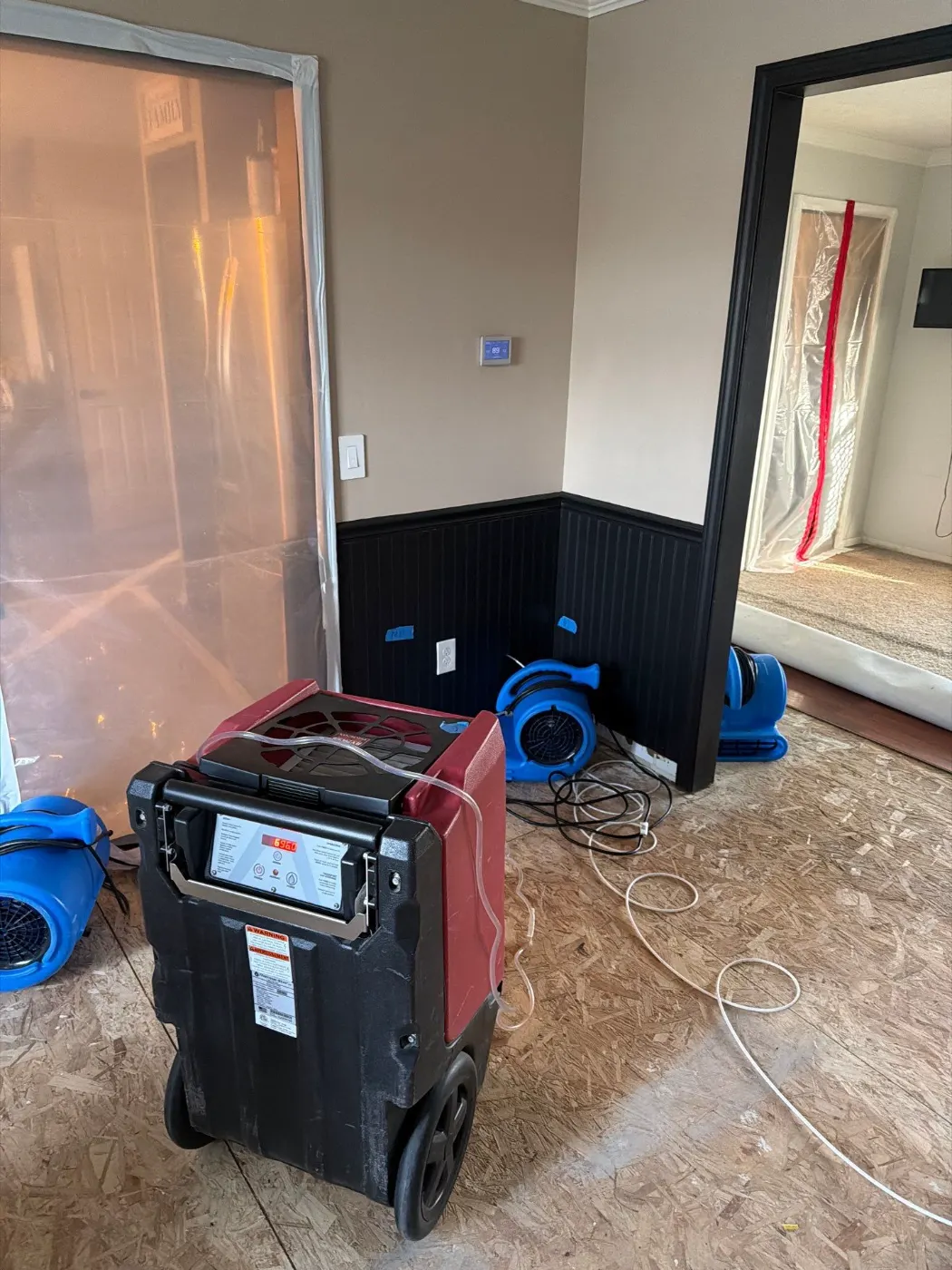
By the time we arrived ninety minutes after her call, moisture readings in the subfloor were reading 38 percent, well past the 16 percent threshold where structural drying becomes urgent. We pulled carpet pad in three rooms, set twelve air movers and two LGR dehumidifiers, and started monitoring twice a day. Total dry time was four days. Her insurance carrier covered the loss under sudden and accidental discharge, which is how most frozen pipe claims are categorized. Final invoice landed near $4,800 for mitigation, with reconstruction billed separately. If you want a fuller breakdown of how these numbers come together, our burst pipe water damage cost guide walks through every line item.
What made this job manageable was the call timing. She phoned us within 2 hours of discovering the squish, before the water had time to migrate down through the garage ceiling and into the slab. Had she waited until Monday morning, we would have been looking at saturated drywall on two floors, ruined garage storage, and a likely insulation rebuild. The Lake Forest Water Restoration crew chief on that job still references it when training new technicians on why thermal imaging matters in the first ten minutes.
When to call a professional in Lake Forest
If water is still spreading, if a ceiling is bowed, or if you smell anything musty within a day of the burst, do not wait. Call Lake Forest Water Restoration and we will give you a straight read on whether you need full mitigation or whether you can handle the cleanup yourself with a few rentals. We answer 24 7, we work directly with your insurance carrier, and if the job is outside our scope we will say so and refer you to someone who can help.
If Your Pipe Just Burst, Do This Now
Shut the main water valve. Kill power to any affected room at the breaker. Move what you can lift off the wet floor. Take pictures of everything before you touch it. Then call a restoration company that picks up the phone in winter, not a voicemail box that returns calls Monday.
The Vacant Rental That Cost an Owner $31,000
A landlord with a property on the east side of Lake Forest thought he had winterized correctly before a tenant turnover. He shut the main, but he never opened the faucets to drain residual pressure, and the heat had been bumped down to 50 degrees to save on the gas bill. During a four day cold snap, two pipes in the kitchen wall and one in the laundry froze and split. Nobody noticed for nine days. When the next showing happened, water was running out the front threshold.
We pulled three feet of drywall throughout the first floor, removed cabinets, extracted standing water from the basement (the laundry leak had migrated down), and ran equipment for nine days. Mold colonies had already started on the back of the baseboards. The final cost between mitigation, mold remediation, and rebuild touched $31,000. His insurance paid most of it but applied a vacancy clause penalty because no occupant had been there for 72 hours. The lesson we share with every Lake Forest rental owner: keep heat at 60 minimum, leave one faucet trickling, and check the property every other day during deep freezes.
What We Do When We Arrive at Your Lake Forest Home
A homeowner in Lake Forest called us at 9:47 p.m. last winter with water pouring through a kitchen light fixture. We were on site by 10:35. The first technician shut the main while the second started moisture mapping with thermal imaging and pin meters. Within forty minutes we had identified the failed pipe, captured the standing water with truck mounted extraction, and set the initial drying configuration. Photos and readings went straight into the claim file for her adjuster.
That sequence is what professional water damage restoration looks like when it is done right. We document everything, we follow IICRC S500 standards for category and class assessment, and we communicate with your insurance carrier directly if you want us to. If your basement is involved (and with frozen pipes it often is once gravity gets involved), our basement flooding response team handles extraction, sanitization, and structural drying as one continuous job.
What These Stories Have in Common
Across hundreds of frozen pipe calls in Lake Forest, the same patterns repeat:
- The split is rarely where you think. Ice expands at the freeze point, but the pipe usually fails at the weakest fitting nearby, often inside an exterior wall or above an unconditioned space.
- Insurance pays for sudden discharge but not for the freeze itself. Carriers will cover the water damage repair but deny the pipe replacement if they decide you failed to maintain heat.
- The first hour matters more than the next ten. Standing water at category 1 cleanliness becomes category 2 within 24 hours and category 3 if it touches contaminated materials. Acting fast keeps your category, and your bill, lower.
- Hidden moisture is the real enemy. Surface water dries in a day. Wet framing and insulation take a week with the right equipment, and a month without it.
The Crawl Space Surprise in
A retired couple called on a Tuesday morning because their kitchen floor felt cold and spongy. No visible water anywhere. We crawled their vented crawl space and found a pinhole spray from a frozen and refrozen PEX joint, soaking the insulation batts and the underside of the subfloor. The water had been running intermittently for two weeks every time the heat cycled the pipes warm and cold. We removed 400 square feet of saturated batt insulation, treated the joists with an antimicrobial, dried the cavity over six days, and replaced the insulation with closed cell foam in the rim joist area.
That job ran about $6,200. The takeaway: frozen pipe damage does not always announce itself with a ceiling stain. Sometimes the only clue is a floor that feels wrong. We have seen the same pattern in older Lake Forest homes with knob and tube era plumbing routed through vented crawls, where a single cold snap exposes a half century of marginal insulation work in one afternoon.
The Refreeze Risk Most Homeowners Miss
One Lake Forest family called us back three days after we finished their original dry out because a second pipe had failed in the same wall cavity. The first split had been repaired, but the underlying problem (zero insulation behind the kitchen sink on a north facing exterior wall) was never addressed. When the next cold front pushed through, the replacement copper froze in roughly the same spot. We now walk every customer through a post thaw vulnerability check before we close the file. That conversation takes ten minutes and has saved at least a dozen Lake Forest Water Restoration clients from a repeat claim in the same winter.
Frequently Asked Questions
How fast can Lake Forest Water Restoration get to my Lake Forest home after a pipe bursts?
For most Lake Forest addresses we are on site within 60 to 90 minutes of your call, 24 hours a day during winter freeze events. We stage extra crews when forecasts drop below 15 degrees.
Will my homeowners insurance cover a frozen pipe burst?
Usually yes, under sudden and accidental water discharge, as long as you maintained reasonable heat in the home. Carriers may deny claims on vacant properties or if heat was off. We document everything to support your claim.
How much does frozen pipe water damage cost to repair in Lake Forest?
Mitigation alone typically runs $2,500 to $7,500 depending on affected square footage and saturation. Full restoration including drywall, flooring, and paint can range from $5,000 to $30,000 or more for severe cases.
How long does drying take after a frozen pipe burst?
Structural drying usually takes 3 to 7 days with proper equipment. Hidden moisture in framing or under cabinets can extend that. We monitor daily and only pull equipment when readings hit dry standard.
Should I call a plumber or Lake Forest Water Restoration first?
If water is still flowing, shut your main and call a plumber to fix the pipe. Call Lake Forest Water Restoration immediately after for water extraction and drying. We coordinate with your plumber so nothing gets missed.
Have a restoration question?
Our IICRC certified Lake Forest crew is ready to help. Free assessments, estimate based on what we can sees, no pressure.